
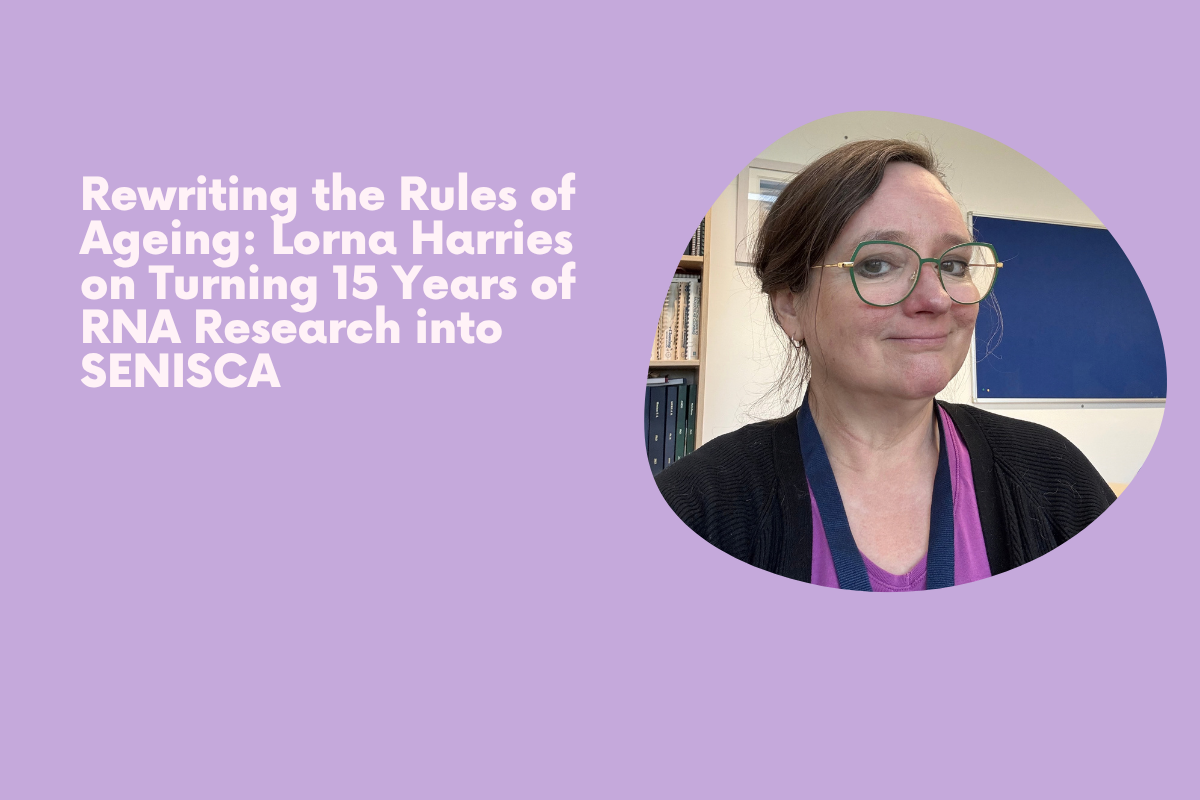
Professor Lorna Harries spent 15 years studying RNA processing before she ever thought about starting a company. That research, carried out at the University of Exeter, led to a striking discovery: dysregulated RNA processing is a previously unrecognized driver of cellular ageing, and it can be targeted to restore healthy RNA function and reprogram aged cells into a less damaging, more functional state. That finding became the foundation for SENISCA, the biotech she co-founded to bring the science out of the lab and into real-world use.
For Lorna, the leap from academic discovery to company wasn't something she set out to make. It wasn't until her lab's first paper on reprogramming cells through RNA processing was published, and interested parties started reaching out, that she began to see the commercial potential in what had been a purely scientific pursuit. That shift changed how she now views her own research: everything has translational potential, and with much of the underlying work funded by taxpayers, she feels a real obligation to turn it into something with public benefit.
In this Q&A, Lorna talks about the moment her research turned into a business, why cellular senescence is a common thread running through so many age-related diseases, and the advice she'd give other women scientists considering the same leap: build a team with the skills you don't have, treat it as a chance to learn, and don't wait until you feel fully ready to jump in.
Know a founder (or are one) doing incredible work? Founded by Women Awards are open for entries. If you're building something bold, leading with purpose, or driving change in your industry, we'd love for you to enter. 👉 foundedbywomen.org/awards
Q: What led you to co-found SENISCA out of your research at the University of Exeter, and what does the discovery around RNA splicing and cellular ageing actually mean for how we might one day treat age-related disease?
SENISCA grew out of 15 years academic research from my lab. We founded the company because we wanted to see the discovery actually do something useful in the real world. Our discovery means that it may be possible to treat multiple diseases of ageing by targeting a common cause, not trying to deal with the consequences of established disease processes. We have established dysregulated RNA processing as a new cause of cellular ageing, and importantly, demonstrated that we can efficiently target it for restoration of correct RNA homeostasis and reprogramming of aged cells back to something les damaging and more functional. Cellular ageing (senescence) contributes to many age-related diseases, which means that this technology has multiple downstream applications.
Q: Can you share a moment where you realized this research had real potential to become a company, not just a lab discovery?
To be honest I had not really considered that our work had potential to become a company until our first paper describing that intervening in RNA processing could reprogram cells published. Until then it was really just a fascinating scientific discovery. It wasn’t until I started getting serious outreach from potential interested parties that I started to think about what we might do with it. Until fairly recently, academics (at least in the UK) have not really been as clued up on potential commercial applications of our emerging tech as they are now. Co-founding SENISCA has fundamentally changed how I see our research – I see translational potential in everything we do now. The driver is to have real impact, on people and society, not just on basic science! Much of the underpinning research is funded by tax payers, so I think we have a moral obligation to develop things with real potential for public good.
Q: What's one piece of advice you'd give other women scientists considering spinning their research out into a business?
Hold your nose and jump! It’s a scary prospect, particularly when you have never really thought about doing something like this – I certainly hadn’t! Surround yourself with a good team who bring skills that you don’t possess and embrace it as an opportunity to learn a whole range of new skills that haven’t really been a standard part of academic training. It’s hard work but rewarding in so many ways. I feel like we are really making a difference.



.png)