Why Your Best Content Stops Ranking After Two Years
A page can rank well for two years and then quietly fade without anyone touching it. Here is why content decays, how to spot it, and why refreshing a page beats rewriting it.
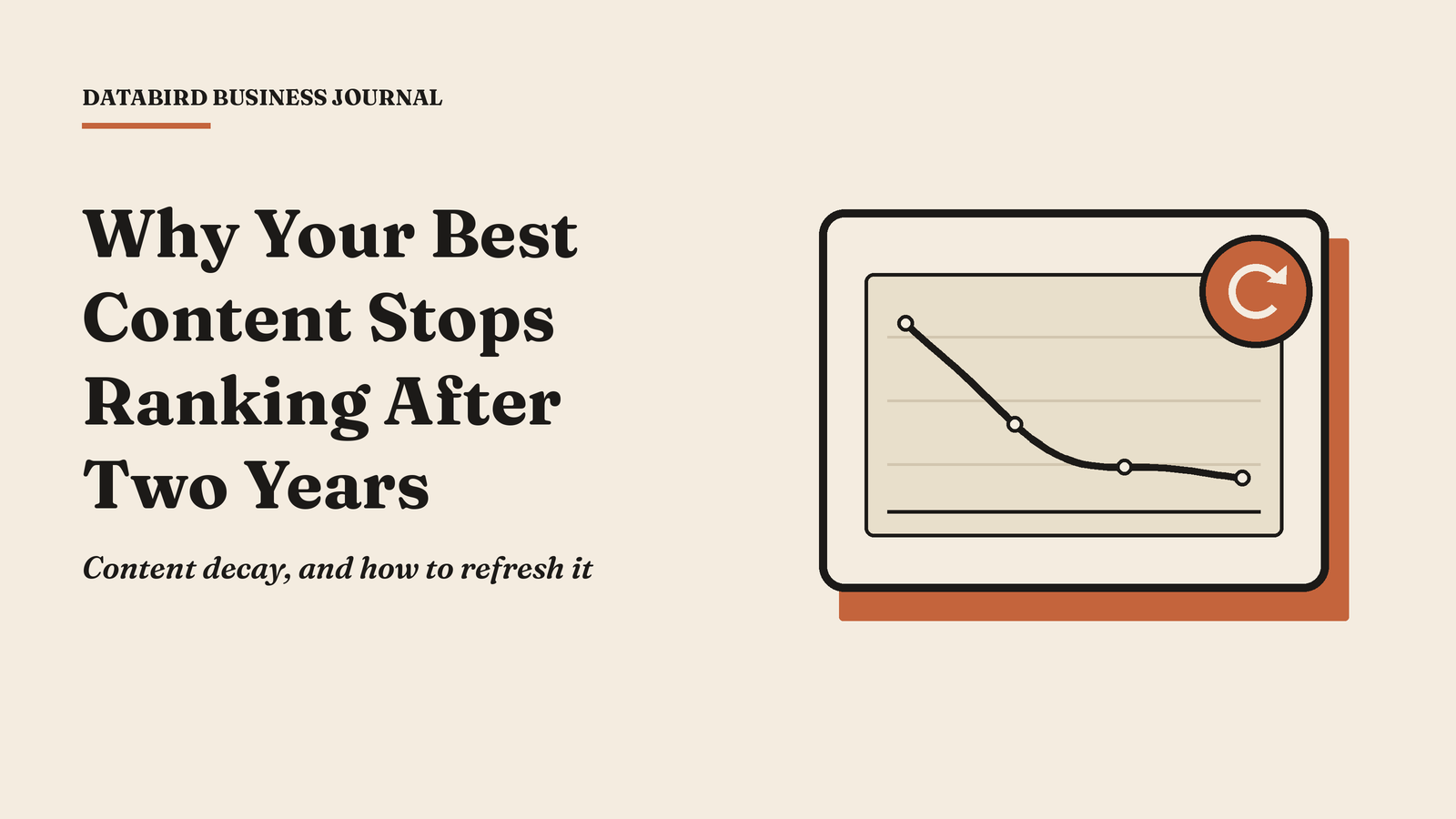
There is a particular kind of frustration that comes from watching a page you were proud of slide down the results. It ranked well for a year, maybe two. Nobody touched it. Nothing broke. And yet the traffic it once brought in has quietly thinned out to almost nothing.
This happens to almost every site that has been publishing for a while, and it is rarely the result of a penalty or an algorithm update that singled you out. It is decay, and it is predictable enough that you can plan for it.
Nothing changed on your page, which is the problem
A search ranking is not a score your page earns once and keeps. It is a comparison, refreshed constantly, between your page and everything else competing for the same query. Your page stayed exactly as it was. The comparison did not.
Three things tend to happen in the background. Competitors publish newer, more thorough pieces on the same topic. The way people phrase the query shifts, sometimes gradually, sometimes sharply when a new tool or term enters common use. And the search engine itself changes what it considers a good answer for that query, often by favouring formats or depth your page does not offer.
None of those require you to have done anything wrong. They simply mean the page that was the best available answer in its first year is now the third or fourth best available answer, and the traffic follows that ranking down.
Ageing content is not the same as decaying content
An old page is not automatically a problem. Plenty of pages published years ago still rank because the topic has not moved and the page still answers the question properly. A reference page explaining a stable concept can sit untouched for a long time.
Decay is specific, and it shows up in patterns rather than in one bad month:
- Impressions holding steady while clicks fall away, which usually means you are still being shown but the listing has lost its appeal or slipped below the fold
- A slow, consistent slide in average position over several months rather than a sudden drop
- The page still ranking, but for a narrower set of queries than it used to
- Facts, prices, product names or tool references in the copy that are visibly out of date to a reader
That last one matters more than people expect. A reader who spots one stale detail discounts the whole page.
A refresh is not a rewrite
The instinct when a page decays is to start again. That is usually the wrong call, and it is expensive. A page that ranked well has accumulated something valuable: links pointing at it, a settled URL, and a track record with search engines for that topic. Deleting it and publishing something new throws that away.
A proper refresh keeps the page and the URL, and works on the parts that have aged. In practice that means updating anything factually stale, adding the sections that competing pages now cover and yours does not, and reworking the introduction so it answers the question faster. It often means restructuring rather than adding, because pages that have been edited repeatedly over the years tend to sprawl.
It also means revisiting the title and the description. These are the parts of the page most readers actually see, and they are frequently written once and never looked at again, even as the page beneath them changes.
Worth checking too whether the topic has fragmented. A single page that once covered a broad subject may now be competing against several specialised pages, each covering one part of it in depth. In that case the answer is not to make your page longer but to split it, keeping the original as the overview and giving the sub-topics their own pages.
Deciding what is worth the effort
You cannot refresh everything, and most sites should not try. The work is worth doing where the page still targets a subject that matters commercially, still has some ranking presence to build on, and sits on a topic where you can genuinely say something more useful than the pages now beating you.
Pages that fail all three tests are usually better consolidated into something stronger or left alone. There is a reasonable argument that a large share of most content libraries is doing nothing and quietly costing attention, and the discipline involved in content curation applies just as much to your own archive as it does to material you gather from elsewhere.
Prioritising this properly is one of the more useful things a good SEO agency like SIXGUN does, because it requires looking at ranking data, commercial value and competitive difficulty at the same time, and most teams only have easy access to one of those.
Make it a scheduled job, not a rescue mission
The businesses that handle decay well are not the ones that react fastest. They are the ones that stopped treating published content as finished. A quarterly review of the pages that matter most, checking position trends and click-through rather than raw traffic, catches decay while it is still cheap to fix.
Build it into the calendar the same way you would any other maintenance. Set a small number of pages to review each quarter, look at where they were and where they are now, and decide deliberately whether each one gets a refresh, a consolidation or nothing at all.
The wider direction of travel is worth keeping an eye on as well, because what search engines reward shifts, and staying loosely across SEO trends helps you tell a page that has genuinely aged out from one that is simply between updates.
Content is not a stock of assets you build up and hold. It behaves more like equipment. Left alone it degrades, and the cost of maintaining it is always lower than the cost of replacing it.