Why Asset Protection Has to Start Before the Dispute: A Q&A with Asher Rubinstein
Asher Rubinstein, partner at Gallet, Dreyer & Berkey, on why asset protection works best before a dispute, the mistakes owners make with crypto and personal assets, and how offshore structures really work.
Many business owners only think about protecting their assets once a claim has surfaced. By then, the options narrow quickly, and a transfer made to get away from a known creditor can be challenged as a voidable transfer.
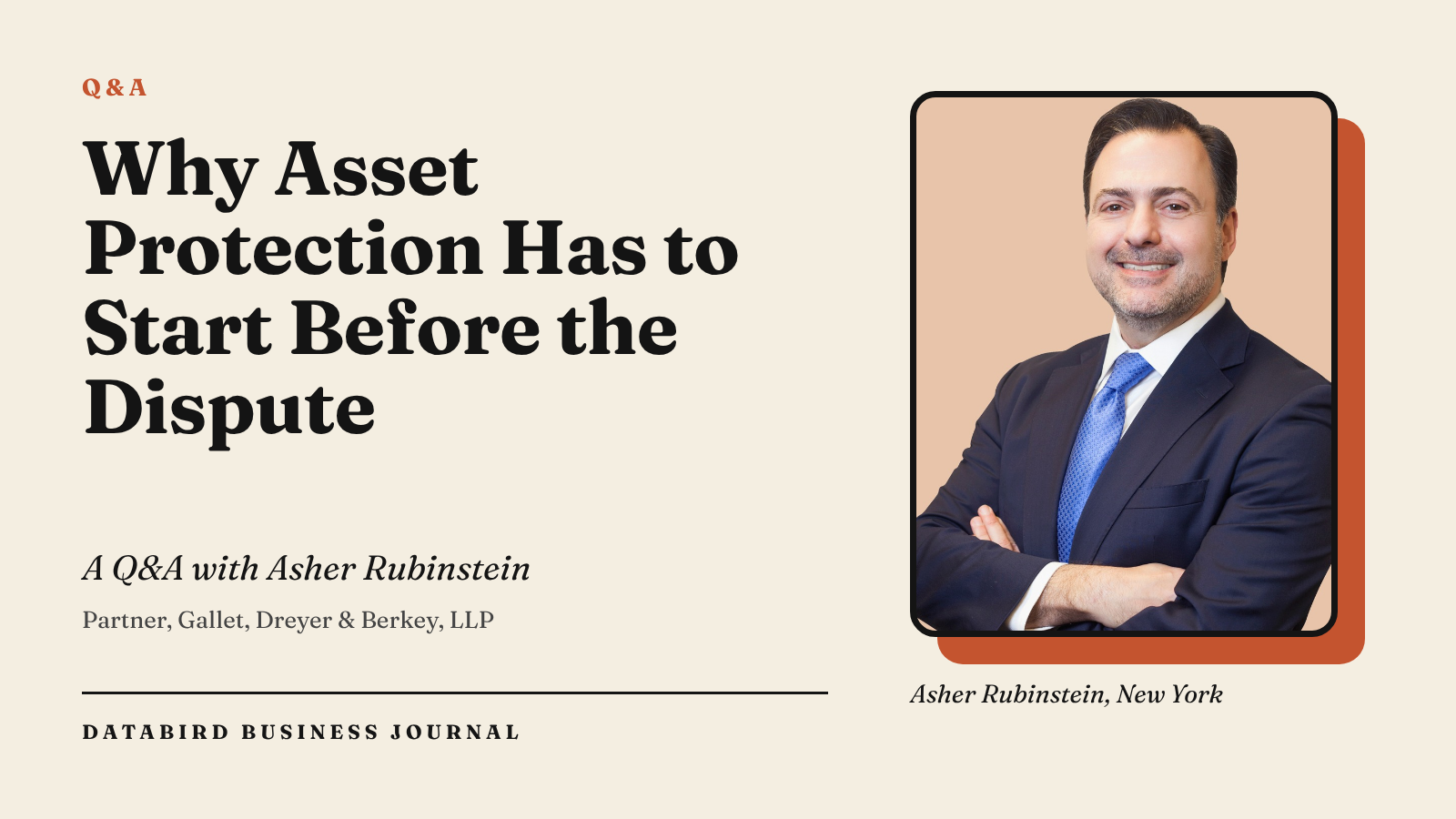
Asher Rubinstein is a partner at Gallet, Dreyer & Berkey, LLP, in New York City. He has practiced law for thirty years, and his practice focuses on domestic and international asset protection, wealth preservation, estate planning, tax planning, tax controversy, offshore tax compliance, and related litigation.
In this Q&A, Asher explains why timing matters so much, which structuring mistakes he sees most often, including with crypto held in cold storage, and what business owners should understand before using an offshore structure.
Crypto Law Summit is a webinar series for legal and compliance professionals working with digital assets. Sessions run as live fireside chats with a moderator, and speakers share practical insight with a community of 1,000+ lawyers and compliance professionals. 👉 cryptolawsummit.org
Q: When should business owners start thinking about asset protection, and why is it so much harder to do once a dispute has already started?
Business owners should start to think about asset protection well before any problems or threats arise. Once there is a dispute, or a potential claim against the business, it becomes more difficult to protect assets.
If the “waters are calm”, so to speak, and there are no identifiable, probable creditors, then engaging in asset protection is easier and less vulnerable to challenge. However, if there are already actual or potential creditors - a business dispute, an accident, a claim of injury, a default on an obligation - then asset protection could be challenged as a voidable transfer, i.e., a transfer of assets to avoid an identifiable, known creditor.
Therefore, it is much better, more effective, and less vulnerable to challenge if a business owner protects assets prospectively, before the threat rather than defensively, after the problem arises.
Q: What are the most common mistakes you see business owners make when structuring their assets, including digital assets such as crypto?
A major mistake is owning assets in one’s individual name. If you own assets, whether your home, your bank accounts, even your crypto, in your own name, and you get sued personally, then any assets owned in your own name are vulnerable to be taken if you lose the lawsuit. Even crypto in cold storage is vulnerable because in a lawsuit, you could be asked in a deposition or interrogatories about your assets, and you would have to be truthful or else you would be committing perjury, which is a criminal offense.
Another mistake is not having adequate insurance. Even if your assets are properly protected in structures including LLCs or limited partnerships, proper insurance is often a first line of defense that could serve to avoid a lawsuit. If you get sued, and your assets are properly protected, you have a defensive shield. But insurance could avoid a lawsuit in the first place.
Q: How should owners think about offshore structures today, and what should they understand before using one?
Offshore asset protection is the strongest form of asset protection, because the assets are physically removed from the jurisdiction of the U.S. legal system. The assets are transferred to an independent country which does not recognize U.S. court judgments. We chose offshore jurisdictions that offer political, economic, and social stability, with a strong rule of law and well-regulated banks and service providers like trustees. A U.S. creditor would have to go to that foreign jurisdiction and begin a legal action there. In that offshore jurisdiction, a U.S. creditor would be forced to overcome major legal and procedural impediments, such as no contingency legal fees, a requirement to post a bond, short statutes of limitations, and difficult burdens of proof. Offshore asset protection works because of the geographic, jurisdictional, and procedural obstacles between a U.S. creditor and assets protected offshore.
While offshore asset protection is very strong, U.S. business owners must understand that assets are physically transferred to the offshore jurisdiction. So, cash could be wire transferred offshore, but U.S. real estate cannot. In addition, U.S. business owners have to understand that they no longer own the assets. Ownership is in the hands of a well-credentialled, regulated, licensed, and insured foreign trustee, who is not subject to U.S. jurisdiction. Finally, U.S. business owners should understand that there is no U.S. tax avoidance on assets transferred offshore. This must be done with complete and proper disclosure to the IRS. The assets are protected offshore, but they are not “hidden” behind any so-called banking secrecy.
About the Author
Asher Rubinstein has practiced law for thirty years and is a partner at Gallet, Dreyer & Berkey, LLP, in New York City. Asher’s practice focuses on domestic and international asset protection, wealth preservation, estate planning, tax planning, tax controversy, offshore tax compliance, and related litigation. Mr. Rubinstein is a recognized expert on offshore entities, foreign banking, and IRS compliance issues.

