Migrating Data Off Ageing Industrial Control Systems Without Halting Production
Migrating Data Off Ageing Industrial Control Systems Without Halting Production
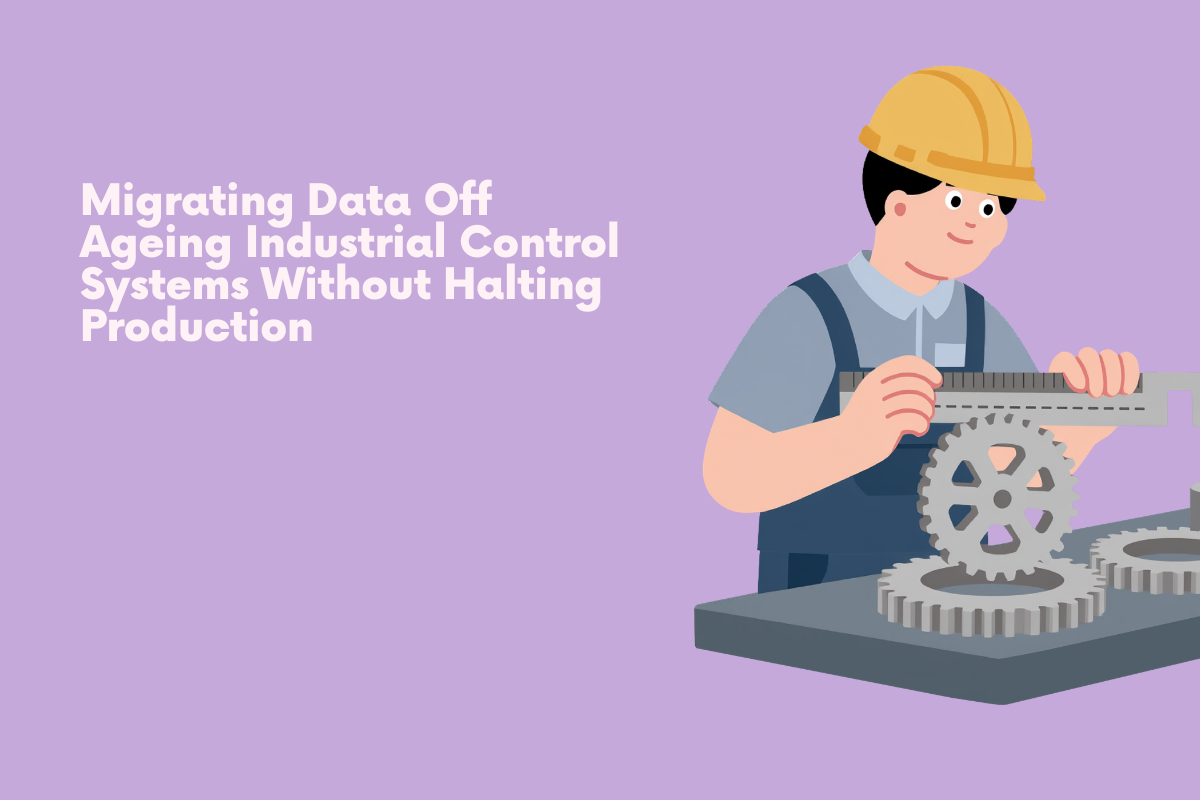
In many industrial facilities, some of the most critical data in the entire operation lives on systems that are quietly approaching the end of their usable life. Legacy programmable logic controllers, aging SCADA installations, and control systems built decades ago continue to run production lines, capture process data, and hold years of operational history. Replacing or migrating away from them is increasingly necessary, but it comes with a constraint that makes the job genuinely difficult: the plant cannot simply stop. Migrating data off ageing industrial control systems while production keeps running is one of the more demanding challenges in modern industrial engineering, and it rewards careful planning far more than raw speed.
Why Legacy Control Systems Become a Liability
Older control systems do not fail all at once; they become liabilities gradually. Spare parts grow scarce as manufacturers discontinue support. Engineers who understood the original programming retire or move on. Proprietary formats and obsolete communication protocols make the data harder to reach with every passing year. And the security posture of systems designed before modern cyber threats existed becomes increasingly difficult to defend.
The data trapped inside these systems is often the most valuable thing about them: years of process history, recipes, calibration settings, and operational records. The longer a migration is postponed, the greater the risk that this data becomes genuinely inaccessible, stranded on hardware nobody can service and in formats nobody can easily read.
The Core Challenge: Continuity
The defining difficulty of an industrial data migration is that it happens on a living system. Unlike an office IT migration that can wait for a weekend, a production environment often runs continuously, and unplanned downtime carries costs measured in thousands of dollars per hour, missed commitments, and disrupted supply chains.
This continuity requirement shapes everything about how a migration must be approached. The work has to be planned around production realities, executed in ways that do not interrupt the process, and validated carefully at every step. It is less like swapping out a component and more like performing maintenance on a moving vehicle, which is exactly why it demands specialized expertise rather than a generic IT approach.
Planning the Migration Before Touching Anything
The single most important phase of an industrial data migration happens before any data moves. A thorough assessment maps what data exists, where it lives, what formats it uses, and how it connects to live processes. This discovery stage surfaces the dependencies and risks that, if missed, become the disasters that halt production.
Good planning also identifies which data is genuinely needed going forward, how it will be translated into modern formats, and what the rollback plan is if something goes wrong. A migration attempted without this groundwork is a gamble; one built on a detailed map of the existing environment is a controlled, predictable process.
Executing Without Halting Production
With a plan in place, the migration itself can be structured to protect continuity, and experienced integrators use several strategies to do exactly that. Specialists in industrial automation approach these projects by phasing the work, running old and new systems in parallel where possible, and scheduling critical cutover steps around production windows so that the process is never left exposed.
Parallel operation is often the key technique: the new system runs alongside the legacy one, capturing and validating data in real conditions before anything is switched over. This allows engineers to confirm the new system behaves correctly against the live process while the old system remains the source of truth, and only when the new system has proven itself does the actual cutover occur. Done well, the transition is nearly invisible to the production floor, which is precisely the goal.
Validating Data Integrity
Moving data is only half the job; proving it arrived intact is the other half. In an industrial context, a subtle data error can have serious consequences, corrupting a process recipe, misreporting a safety-critical measurement, or breaking a regulatory record. Validation is therefore not a formality but a core part of the migration.
Thorough validation compares source and destination data, confirms that historical records remain accurate and complete, and verifies that the new system produces the same results as the old under real conditions. Only once the data integrity is demonstrably sound can the legacy system be retired with confidence.
Security and Standards in Modern Systems
A migration is also an opportunity to close the security gaps that legacy systems carry. Guidance from the National Institute of Standards and Technology, which publishes widely used frameworks for operational technology and industrial control system security, underscores that modernized systems should be designed with security built in rather than bolted on afterward.
For a facility undertaking a migration, this means treating the new system's security as part of the project scope from the start: network segmentation, access controls, and monitoring designed in during the migration rather than retrofitted later. Modernizing the data and the security posture together is far more efficient than treating them as separate projects, and it ensures the new system is defensible against threats the old one never anticipated.
Turning a Risk Into an Upgrade
Approached carelessly, migrating off a legacy control system is a threat to production. Approached properly, it is an upgrade that reduces risk, unlocks trapped data, improves security, and positions a facility for the analytics and connectivity that modern operations increasingly depend on. The difference lies entirely in the planning, the expertise, and the discipline of validation.
The facilities that handle these migrations well treat them as engineering projects deserving of specialist attention, not IT chores to be squeezed in. They plan thoroughly, protect continuity above all, validate rigorously, and emerge with modern systems that will serve for years. For any operation still relying on ageing control systems, the question is not whether to migrate but how to do it safely, and the answer is to start planning well before the old system forces the decision.