How Leaders Can Build a Workforce Strategy for Continuous Disruption
Nearly 40% of job skills are expected to change by 2030. Here is how leaders of small teams can build a workforce strategy around skills, flexibility and the capacity to adapt.

Nearly 40% of the skills people use on the job are expected to change by 2030, according to the World Economic Forum's Future of Jobs Report 2025. For a large company, that's a planning problem. For a founder with a team of eight, it can feel like the ground moving every quarter.
The old approach was to write a headcount plan in January and hire against it all year. That plan rarely survives contact with a new AI tool, a lost client or a sudden growth spurt. So what does work when change is the normal state of things?
The short answer: a workforce strategy built around skills, flexibility and people's capacity to adapt, reviewed often enough to stay useful. Here's how to put one together without a big HR department.
Why yearly headcount plans keep breaking
Most small businesses plan people the way they plan budgets: once a year, by role. "We'll need a marketing manager in Q2 and two more customer support reps by the fall."
The trouble is that roles are a guess about which skills you'll need, frozen in time. When the work shifts, the plan doesn't.
There's a second problem, and it's about your team rather than your spreadsheet. Gartner found that 74% of employees were willing to support organizational change in 2016, but only 38% said the same by 2022. People are tired of change that happens to them. A strategy for constant disruption has to account for that, or it will burn out the very people it depends on.
Start with skills, not job titles
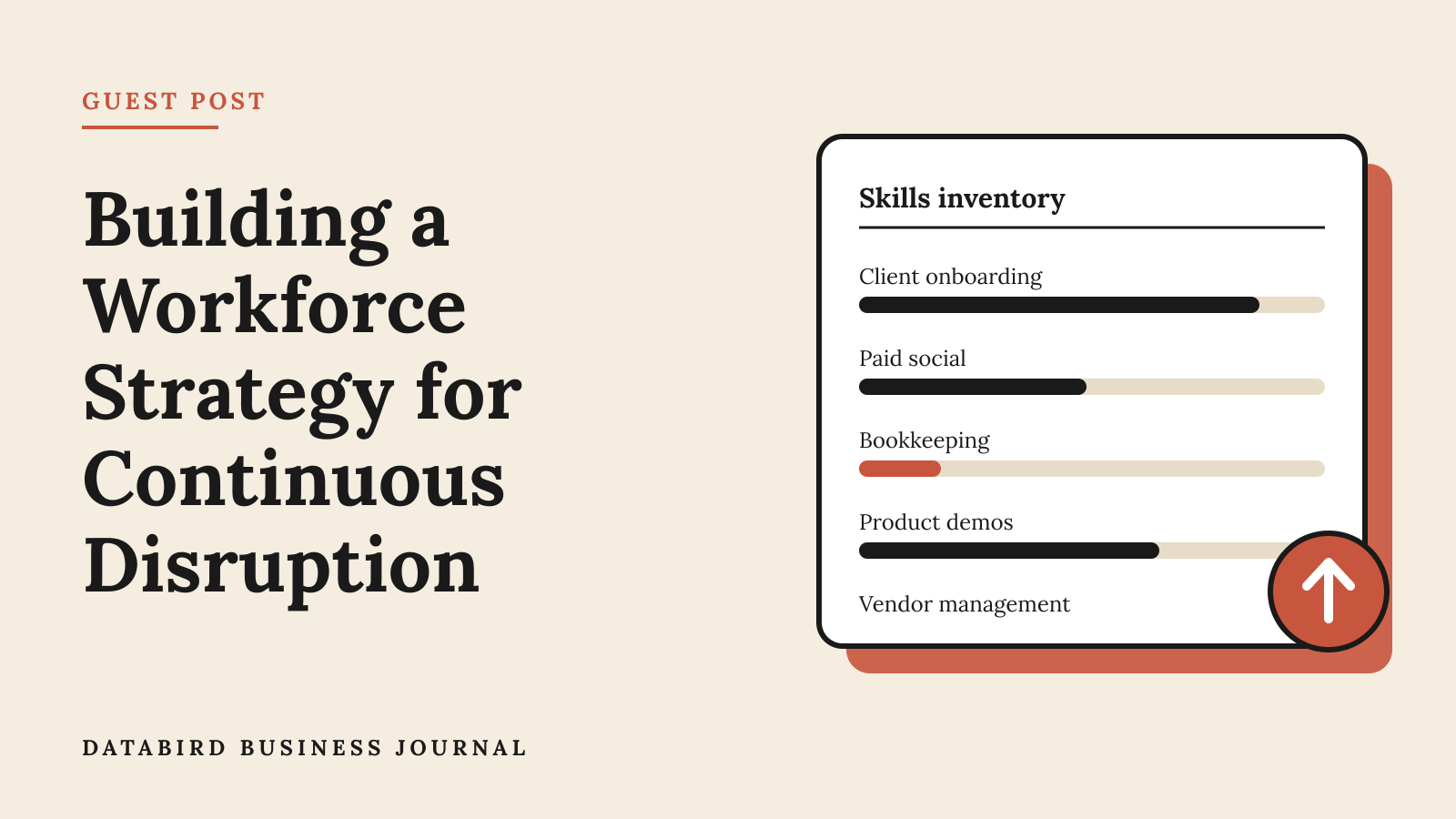
Before you decide who to hire, get clear on what your business actually needs people to be able to do. A simple skills inventory takes an afternoon:
- List the work, not the roles. Write down the 15 to 25 capabilities your business runs on, such as client onboarding, paid social, bookkeeping, product demos and vendor management.
- Map who can do each one today. Mark whether each person is strong, developing or new to it. You'll quickly spot single points of failure.
- Flag what's changing. Which of these will look different in 12 to 18 months because of new tools, new customers or new regulations?
- Name the gaps. These are your real hiring and training priorities, and they're often different from the roles you assumed you'd need.
This view does something a headcount plan can't. It shows you where one resignation would stall the business, and where a little training would cover a gap faster than a new hire.
Hire for what people can do
Once you're thinking in skills, it makes sense to hire that way too. Plenty of employers have already made the shift. In NACE's Job Outlook 2026 survey, 70% of employers said they use skills-based hiring, up from 65% a year earlier.
For a small team, the appeal is practical. Dropping a degree requirement that doesn't predict performance widens your talent pool. Testing for the skill itself, with a short work sample or a structured interview, tells you more than a résumé will.
Speed is the other benefit. A Kelly guide for employers explains how skills-based hiring moves faster when the whole process changes with it: sourcing, screening and interviews, rather than only the wording of the job post. That's a useful warning for founders. Rewriting a job description is the easy part. The value comes from agreeing on the three or four skills that matter, then having everyone who interviews score candidates against the same simple rubric.
Keep it light at first. Pick one role you hire for often, try the approach there, and see whether time-to-hire and 90-day retention improve before you roll it out everywhere.
Build a flexible bench
Not every skill gap needs a full-time hire. When the future is uncertain, a mix of core employees and flexible talent gives you room to adjust without layoffs.
Plenty of people already work this way. The U.S. Bureau of Labor Statistics counted 11.9 million independent contractors in July 2023, or 7.4% of total employment. Fractional CFOs, freelance designers and project-based developers are now a normal part of how small companies get work done.
A practical way to think about it:
- Core team: the skills that define your business and need deep context, such as client relationships, product decisions and culture.
- Flexible bench: specialist or spiky work, such as a website rebuild, a funding round or a seasonal rush.
- Grow from within: skills you'll need long term that someone on the team could learn.
Keep a short list of trusted contractors before you need them. Scrambling for help in the middle of a crunch is how small teams overpay and under-deliver.
Make learning part of the job
If your inventory shows skills shifting, training is usually the fastest fix. The World Economic Forum projects that 59 out of every 100 workers will need training by 2030, and 77% of employers say upskilling is part of their plan.
You don't need a learning platform to start. Give each person one skill to build this quarter, protect an hour or two a week for it, and ask them to teach the team what they learned. That last step spreads knowledge and removes single points of failure at the same time.
It also changes how people experience disruption. Learning a new tool feels very different when it's a growth goal you chose than when it's dropped on you with a deadline.
Plan in scenarios and review every quarter
Instead of one plan, sketch three: steady growth, a sharp slowdown and a big opportunity. For each, ask which skills you'd need, which roles you'd pause and who on your flexible bench you'd call.
Then put a 60-minute workforce review on the calendar every quarter. Revisit the skills inventory, check which scenario you're closest to, and adjust. The goal isn't predicting the future. It's shortening the time between noticing a change and responding to it.
Protect your team's capacity for change
All of this fails if your people are worn out. Gartner's research found that only 43% of employees with high change fatigue plan to stay, compared with 74% of those with low fatigue.
The same research points to a fix that suits small teams well: involve people in shaping the change instead of announcing it to them. Ask the team where the skills inventory looks wrong. Let them suggest which scenario feels most likely. Give the person closest to the work a say in how a new tool gets rolled out.
When it comes time to hire, look for the qualities that help people adapt. Hiring guides on what employers really want keep returning to the same traits: willingness to learn, clear communication and good judgment under pressure. Add them to your interview rubric so they're assessed on purpose, not by gut feel.
Where to start this month
You don't need to do everything at once. Pick three moves for the next 30 days:
- Run a one-afternoon skills inventory and mark your biggest single point of failure.
- Choose one role to pilot skills-based hiring, with a shared rubric for everyone who interviews.
- Book your first quarterly workforce review and invite one or two team members to help shape it.
Disruption isn't going to slow down. But a team that knows its skills, has backup when it needs it and has a say in how change happens is far better placed to handle whatever the next quarter brings.