Common SysML Myths That Hold MBSE Teams Back
Most MBSE efforts struggle not because SysML is inherently difficult, but because teams begin with mistaken ideas about what it is and how it should be used.
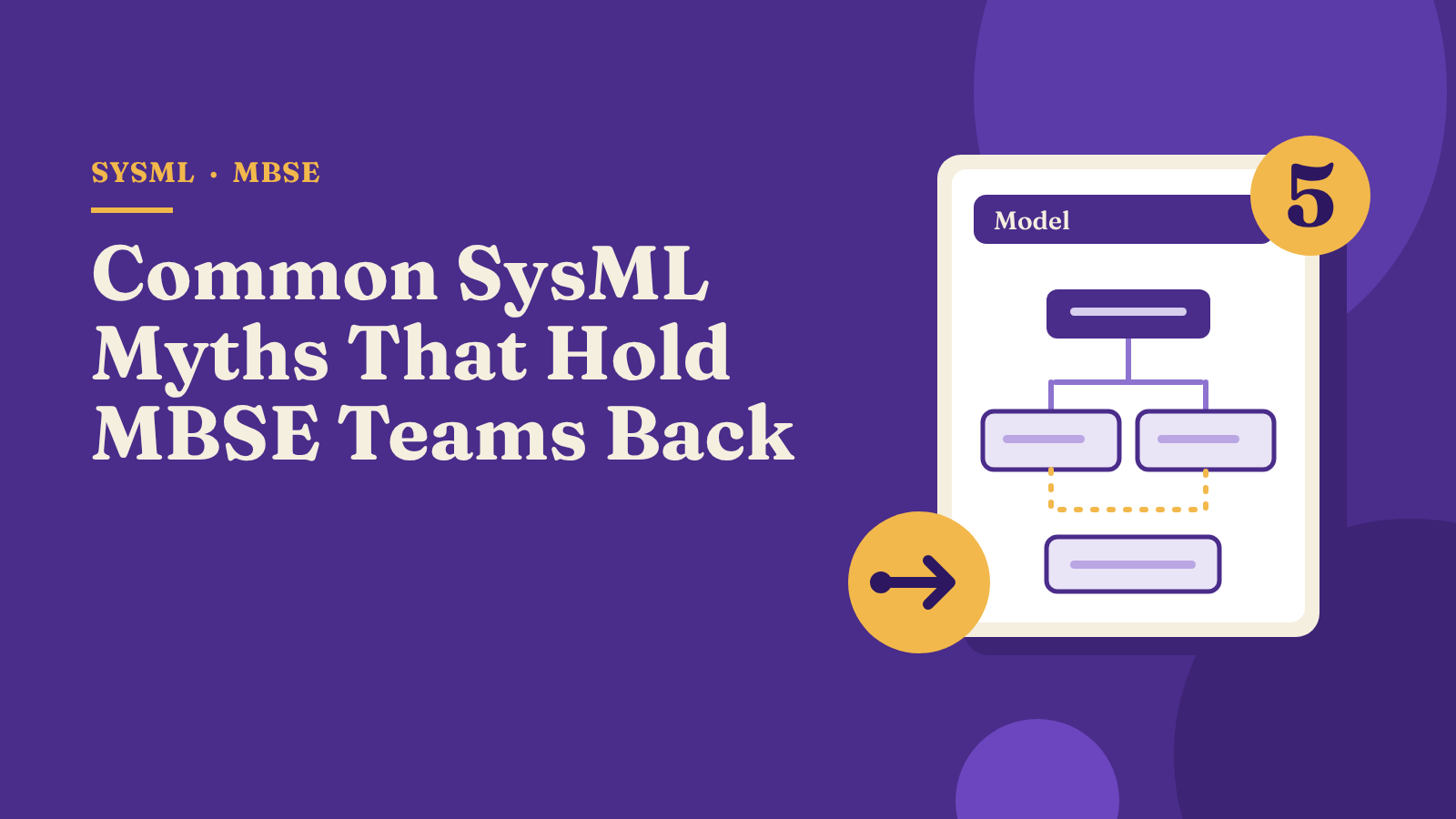
Most MBSE efforts struggle not because SysML is inherently difficult, but because teams begin with mistaken ideas about what it is and how it should be used.
SysML is just UML for systems engineers
This misconception persists because it contains a grain of truth. SysML grew out of UML and retains some of its notation. The Object Management Group publishes both standards, which encourages the assumption that SysML is simply UML with a different label.
That misses the distinction. UML was built to describe software, while SysML removes constructs that only make sense for code and adds concepts needed for systems engineering.
The difference is clear in two diagram types UML does not have. Requirement diagrams let teams break down requirements and connect them directly to design elements and test cases. Parametric diagrams bind mathematical constraints to properties, allowing engineers to run checks that the design must pass. Treating SysML as UML overlooks both capabilities and can reduce a system model to a description of software structure.
Teams that make this mistake often force software patterns onto hardware and physical behavior. The fit is poor. SysML is a graphical modeling language designed around systems, bringing structures, behaviors, requirements, and interconnections into one connected model.
SysML means block diagrams
Ask a casual user what SysML looks like and they may picture boxes and lines. Block Definition Diagrams receive attention because they show hierarchy and part types. Internal Block Diagrams show ports and flows between those parts.
Those views matter, but they do not represent the entire model. A useful SysML model connects structure with behavior and analysis.
Activity diagrams describe behavior involving flow. Sequence diagrams show message exchange, while state machines capture state-based logic. Requirements sit in requirement diagrams with explicit trace links. Parametrics connect performance equations with design values.
Traceability turns a set of pictures into a usable model. When a requirement changes, the model can show which function is affected and which part may need to change. Without those links, teams have drawings. With them, they have connected information that supports engineering decisions.
Trace links are the real work.
SysML is a legacy bet, so we should wait
This concern often appears during a major standards transition. Teams may hesitate to invest after a new version arrives, particularly if they fear their existing models will be stranded.
The OMG formally adopted SysML v2 in 2025, addressing known complaints about v1 directly. Its precision was loose in places, readability suffered in large models, and tool exchange depended too heavily on file exports that often caused problems in practice.
Teams deciding when to commit should therefore examine sysml v2. It is a ground-up revision with tighter semantics and clearer notation. It also adopts an API-first approach, helping tools exchange models without relying on brittle file transfers.
Current work does not need to stop while teams plan migration. Many underlying concepts carry over. Structure remains structure, and requirements still need trace links. The main changes concern how precisely the language defines those concepts and how readily tools can share them.
Waiting can become delay presented as prudence.
Buying a tool makes you MBSE
This can be the most expensive misconception. A manager purchases licenses for Cameo Systems Modeler or IBM Rhapsody, training is scheduled, and the organization expects better engineering by the next quarter.
MBSE adoption requires a shared language that participants interpret consistently, along with a tool that stores that language and checks it for consistency. It also needs a methodology defining who models what, and at which point in the process.
That three-part principle is well established. INCOSE has promoted it for years through its MBSE vision work. Language without method produces tidy diagrams that no one trusts. Method without language leaves disconnected documents. A tool without either can quickly become a place for uncoordinated diagramming.
The same pattern appears in MagicDraw environments. Skilled engineers create detailed views, each of which looks reasonable on its own. Yet names may not match across views, interfaces may not align, and reviewers may struggle to find what they need because no one defined viewpoints for different stakeholders.
Another license will not solve that problem. Teams need agreement on a focused modeling method. They should define the questions each view must answer, establish naming rules, and review the model with the same care applied to hardware.
Good models use every diagram and come last
Two poor habits sit behind this assumption. One treats rigor as completing all nine diagram types, while the other treats modeling as paperwork performed after the design freezes.
Both reduce the model's value. Mature teams do not simply follow a diagram checklist. They select views and viewpoints that answer a specific question or meet a stakeholder need. Interface questions may call for internal block and sequence views. Performance questions may need parametrics supported by relevant activity views. Other diagrams can wait until they serve a clear purpose.
Late modeling is even less useful. Applied early, SysML supports architecture checks, behavior simulation, and parametric trade studies, when teams still have room to respond to the defects they uncover.
Problems found while requirements and architecture are still fluid are generally easier to correct than problems discovered after integration or deployment. That principle should influence planning. Rather than modeling only what has already been built, teams can build from what they have modeled. Keeping the model tied to digital engineering goals helps design and analysis remain connected from the outset.
Model to decide, not to document.
Removing these misconceptions makes the work more direct. Teams can choose the language and tool, agree on the method, and use the model early enough to influence the outcome.